The Douay-Rheims is the oldest Catholic translation of the Bible into English. Its New Testament was first printed at Rheims in 1582 by English Catholic exiles, and for centuries it shaped the prayer and vocabulary of English-speaking Catholics. Many readers today are drawn to it for its reverence and its closeness to the Latin of the Vulgate, but find its English hard going at first.
This guide is about using the Douay-Rheims: how to pray with it, how to study it, and how to get past the strangeness of its language. If you are deciding between Latin Revival’s two editions, our companion article Original 1582 Douay-Rheims vs. Modernized Spelling explains the difference in detail.
Know which Douay-Rheims you are reading
The name “Douay-Rheims” covers more than one text. The New Testament appeared at Rheims in 1582; the Old Testament followed at Douay in 1609–1610. In the eighteenth century Bishop Richard Challoner revised the whole Bible, and most Douay-Rheims Bibles sold today print his revision, whose wording often differs from the original.
Latin Revival publishes the New Testament of 1582 itself, not Challoner’s revision, in two forms: an original old-spelling edition and a modernized-spelling edition. Knowing this matters when you compare passages, quote a verse or follow a commentary keyed to another translation.
Getting used to its English
The Rheims translators worked from the Latin Vulgate, which the Council of Trent had declared the authentic Latin text for public use, and they chose to stay very close to it. The result is English with a Latin accent. Three things help most:
- Read aloud. Phrases like “cometh” and “saith” are easier on the ear than on the page, and the rhythm of the sentences becomes clearer.
- Expect Latin-derived words. The translators deliberately kept terms such as pasch, parasceve and azymes, and they rendered the Lord’s Prayer’s request for bread as “supersubstantial bread.” These are not errors but choices to preserve the meaning of the Latin.
- Use the helps in your edition. The original-spelling edition includes an archaic-to-modern glossary and indexes of books, chapters and key topics. The modernized edition includes a Parables Index and a Places Index. Keep a ribbon at the glossary or index for the first few weeks.
Within a month of regular reading, most of the strangeness fades.
A simple habit for prayer: lectio divina
The Church has long encouraged a slow, prayerful reading of Scripture known as lectio divina. Pope Benedict XVI described its movement in steps: reading the text, meditating on it, praying in response, resting in contemplation, and acting on what God has shown. The Second Vatican Council reminded the faithful that prayer should accompany the reading of Scripture, so that it becomes a conversation between God and the reader.
A simple daily pattern with the Douay-Rheims:
- Choose a short passage, a dozen verses at most. The Gospel of the day, or a chapter of one Gospel read in order, works well.
- Read it slowly, aloud if you can. Read it twice.
- Notice one word or phrase that stands out. Stay with it. What is God saying here?
- Respond in prayer, in your own words: thanks, sorrow, a request.
- Rest a moment in silence.
- Carry one thing into the day, a phrase to remember or a small act of charity.
Fifteen minutes is enough. The point is not to cover ground but to meet Christ in His word.
Habits for study
Prayerful reading and study go together, but study asks a few more tools.
- Read whole books. Read a Gospel or a letter straight through over a week or two, so you know where each passage sits.
- Compare translations. When a verse is unclear, read it in a modern Catholic translation as well. Seeing two English renderings of the same Latin and Greek often clarifies both.
- Read with the Church. The Catechism of the Catholic Church has an index of the Scripture passages it cites; looking up a verse there shows how the Church reads it.
- Keep a notebook. Write the reference, a phrase, and a question. Over months it becomes your own commentary.
- Note what the 1582 edition is. For study of the history of the English Bible or of Catholic responses to the Reformation, the original-spelling edition preserves the text exactly as its first readers saw it.
Choosing an edition for your purpose
- For daily prayer, most readers find the modernized-spelling edition easier: the wording of 1582 is kept, but spellings like “beautie” become “beauty.”
- For historical, literary or close textual study, the original old-spelling edition lets you read the text as it was first printed.
- For both, some readers pray with the modernized edition and keep the original at hand for study.
Let the word lead to the Word
The Church cherishes Scripture because in it the Father meets His children and speaks with them. St. Jerome’s warning, quoted by the Council and the Catechism, still holds: ignorance of the Scriptures is ignorance of Christ. Whatever edition you choose, the aim is the same: to know Him better, and to love Him more.
Sources and further reading
- Second Vatican Council, Dei Verbum, 21–25: Sacred Scripture in the life of the Church
- Pope Benedict XVI, Verbum Domini, 86–87: lectio divina
- Catechism of the Catholic Church, 131–133: Scripture in the life of the Church
- Catechism of the Catholic Church, 2653–2654: the word of God as a wellspring of prayer
- Catechism of the Catholic Church, 2705–2708: meditation
- Catholic Encyclopedia: “Douay Bible”
- Council of Trent, Fourth Session (1546): the decree on the Vulgate
Books in this article
Scripture
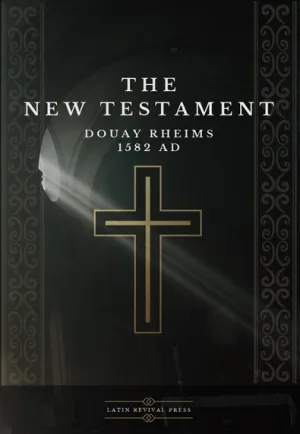
The New Testament — Douay-Rheims (1582 AD), Original Old-Spelling Edition
English College of Rheims
Scripture
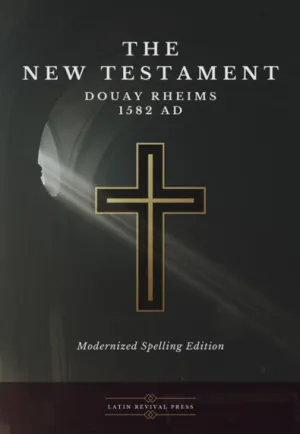
The New Testament — Douay-Rheims (1582 AD, Modernized Spelling Edition)
English College of Rheims
Buy buttons open your country’s Amazon store. As an Amazon Associate I earn from qualifying purchases.