
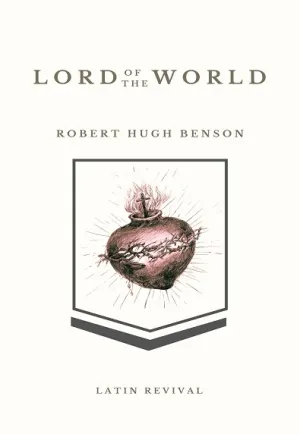
Lord of the World has an unusual reputation for a novel more than a century old. Readers pass it to one another with a certain urgency, and it is often described as prophetic. Pope Francis has recommended it more than once. So it is natural to ask: is it a prophecy?
The short answer is no. It is a work of fiction, written by a priest who imagined where certain ideas of his own day might lead. Read that way, it can be thought-provoking and spiritually useful. Read as a coded timetable of future events, it is misunderstood, and so is Catholic teaching about the end of the world.
Who was Robert Hugh Benson?
Robert Hugh Benson (1871–1914) was the youngest son of Edward White Benson, Archbishop of Canterbury. He was ordained a clergyman in the Church of England, as his father’s son might be expected to be. Then, after years of study and searching, he was received into the Catholic Church in 1903, and he was ordained a Catholic priest in 1904.
He became one of the best-known Catholic writers and preachers in England, the author of historical novels, contemporary fiction, devotional books and an account of his own conversion. He died in 1914, aged only forty-two.
The novel and its world
Lord of the World was published in London in 1907. It is set roughly a century in the future, in a world that has largely given up belief in God. In its place stands a confident humanitarianism: progress, peace and human unity, achieved without religion. Euthanasia is an ordinary part of life. The Catholic Church survives, but shrunken and despised.
The story follows a few characters: a young English priest, Father Percy Franklin; a rising politician and his wife, who share the new faith in humanity; and Julian Felsenburgh, a mysterious and magnetic figure who appears from nowhere and draws the whole world into unity around himself. The tension of the book lies in what that unity costs, and in who will refuse it.
Benson wrote in an age of rapid technological change, of new political movements promising a better world, and of intellectual currents that sought to remake Christianity to fit modern ideas. His novel takes those tendencies of 1907 and follows them to an extreme.
What Benson himself said
Benson did not present the book as a prediction. In 1911 he published a second novel, The Dawn of All, which imagines the opposite outcome: a future in which faith revives. Its preface explains the relationship between the two books. Of the earlier one, he writes, “I attempted to sketch the kind of developments a hundred years hence” that might follow if one direction of thought continued; the new book sketched what might follow if the opposite began.
That is the language of a novelist conducting a thought experiment, not of a prophet announcing events. Benson wrote two futures, because the future was not fixed.
Why Pope Francis recommended it
Pope Francis has spoken of the novel more than once. Returning from the Philippines in January 2015, in a press conference about what he called “ideological colonization,” he told reporters: “It is called Lord of the World. The author is Benson, written in 1907. I suggest you read it.” In a 2013 homily at Santa Marta, as summarized by L’Osservatore Romano, he said the book reads “almost as though it were a prophecy.”
Notice what the Pope commended: the novel’s insight into a spirit of worldliness that seeks unity at the cost of fidelity to God. That is a moral and spiritual insight, not a forecast of particular events.
What the Church actually teaches about the end
The Catechism gives a sober framework. Christ will come again in glory, and “this eschatological coming could be accomplished at any moment.” Before His coming, the Church “must pass through a final trial that will shake the faith of many believers.” The Catechism describes the supreme deception of that trial as “a pseudo-messianism by which man glorifies himself in place of God.” And it teaches that the Church will enter the glory of the kingdom only by following her Lord “in his death and Resurrection.”
The Church also rejects attempts to realise the kingdom of God within history by human power, and Christ Himself warned that no one knows the day or the hour. So a Catholic reader can recognise in Benson’s Felsenburgh an imaginative portrait of the kind of false messianism the Church warns against, while declining to match the novel’s details to current leaders, technologies or dates.
How to read it well
- Read it as a novel. Pay attention to character, atmosphere and choice. Benson’s best moments are human ones: doubt, loneliness, courage.
- Notice what he fears, and what he hopes. The book is dark, but it is not without hope. Watch how faith survives.
- Ask what tendencies are being exaggerated. Satire and dystopia work by enlarging real features of the world. Which ones does Benson enlarge?
- Resist decoding. Matching characters to living people or events to the news leads away from the book’s real questions.
- Keep the Gospel in view. The novel’s final perspective is Christian hope, not fear.
Questions for discussion
- What does the new humanitarian religion promise, and what does it ask in return?
- Why is Felsenburgh so attractive? What kind of peace does he offer?
- How do Percy Franklin’s faith and doubts change through the story?
- What does the book suggest about the Church’s unity and about the papacy?
- Where do you see similar hopes and fears in our own time, and where is the comparison weak?
- How does the Catechism’s teaching on the Church’s final trial help you read the novel’s ending?
Sources and further reading
- Catechism of the Catholic Church, 668–677: Christ’s return and the Church’s final trial
- Pope Francis, in-flight press conference from the Philippines (19 January 2015)
- Pope Francis, morning meditation “We do not negotiate our fidelity to God” (18 November 2013)
- Robert Hugh Benson, Lord of the World (London, 1907), first edition scan
- Robert Hugh Benson, The Dawn of All (1911), with its preface
- Robert Hugh Benson, Confessions of a Convert (University of Notre Dame Archives)
Buy buttons open your country’s Amazon store. As an Amazon Associate I earn from qualifying purchases.