Every Sunday, Catholics stand and profess that the Son is “consubstantial with the Father,” that the Holy Spirit is “the Lord, the giver of life,” and that Christ was “incarnate of the Virgin Mary.” Those words were not chosen casually. Most of them were fixed by councils of bishops between the fourth and eighth centuries, when the Church had to say clearly what she believed about Christ and the Trinity because someone had taught otherwise.
The Catholic Church counts twenty-one ecumenical councils. The first seven, held between 325 and 787, are also received by the Eastern Orthodox Churches, which makes them a shared inheritance of Christians East and West. This guide explains, in plain language, what each of those seven councils faced and what it settled.
What makes a council “ecumenical”?
An ecumenical council is a solemn gathering of the bishops of the whole Church. The Catholic Church teaches that the college of bishops, together with and never without the Pope, exercises its supreme authority in a solemn way in such a council, and that a council is ecumenical only if it is confirmed or at least accepted by the successor of Peter. When a council defines a teaching of faith, the Church receives it as guarded from error.
That is why the councils matter so much: they are not private opinions of theologians but the Church teaching together.
1. Nicaea I (325): the Son is truly God
The question. Arius, a priest of Alexandria, taught that the Son of God was the first and greatest of creatures, but not God in the same sense as the Father.
What it settled. Meeting at Nicaea, the bishops confessed that the Son is “of one substance” (in Greek, homoousios) with the Father, true God from true God, begotten, not made. Their creed is the root of the Creed we pray at Mass.
Why it matters. If the Son is not truly God, then God has not truly come to save us. Every time we say “consubstantial with the Father,” we are using the language of Nicaea.
2. Constantinople I (381): the Holy Spirit is Lord
The question. After Nicaea, some still denied the full divinity of the Holy Spirit.
What it settled. The council reaffirmed Nicaea and expanded its creed, confessing the Holy Spirit as “the Lord, the giver of life,” who “with the Father and the Son is adored and glorified.” The creed professed at Mass is known as the Nicene-Constantinopolitan Creed because it comes from these first two councils. (The words “and the Son” about the Spirit’s procession were added later in the Latin West.)
Why it matters. Christian faith is faith in the Trinity: one God in three divine Persons. Constantinople completed the confession Nicaea began.
3. Ephesus (431): Mary is the Mother of God
The question. Nestorius, archbishop of Constantinople, objected to calling Mary Theotokos, “God-bearer” or Mother of God, and spoke of Christ in a way that seemed to divide Him into two subjects.
What it settled. The council confessed that the one born of Mary is the eternal Son of God made man, one Person. Because her Son is God, Mary is truly the Mother of God.
Why it matters. The title Mother of God is first of all a statement about Jesus: the child in Mary’s arms is God. Catholic devotion to Mary rests on this truth about Christ.
4. Chalcedon (451): one Person in two natures
The question. Some, following the monk Eutyches, taught that after the Incarnation Christ’s humanity was absorbed into His divinity, so that He had only one nature.
What it settled. Drawing on a letter of Pope St. Leo the Great, the council confessed one and the same Christ in two natures, divine and human, “without confusion, change, division or separation.”
Why it matters. Christ is fully God and fully human. He is not a mixture or a disguise. Because He is truly human, He can stand in our place; because He is truly God, His offering saves.
5. Constantinople II (553): the one Person of the Word
The question. Disputes after Chalcedon centred on certain writings, known as the Three Chapters, that were thought to divide Christ again into two subjects.
What it settled. The council condemned those writings and confirmed that there is only one Person in Christ, the eternal Son, “one of the Trinity,” who became man and suffered in the flesh.
Why it matters. It safeguarded the meaning of Chalcedon: the same divine Person is born, suffers and dies for us.
6. Constantinople III (680–681): Christ’s human will
The question. Monothelitism held that Christ had only one will, the divine will.
What it settled. The council taught that Christ has two wills and two natural operations, divine and human, not opposed to each other: His human will freely follows His divine will.
Why it matters. In Gethsemane Christ prays, “not my will, but thine be done.” He truly chose, as a man, to obey the Father. Our salvation was won by a free human “yes” united to the divine will.
7. Nicaea II (787): the holy images
The question. Iconoclasm, backed for a time by the Byzantine emperors, condemned and destroyed images of Christ, Mary and the saints as idols.
What it settled. The council defended the making and veneration of holy images. It distinguished the honour shown to images, which passes to the person depicted, from the adoration that belongs to God alone.
Why it matters. Because the invisible God became visible in Christ, He can be depicted. Crucifixes, icons and statues in Catholic churches and homes rest on this council’s teaching.
Why the councils still matter
- They gave us the Creed. The councils show that the words of the Creed were weighed and defended at great cost.
- They defined rather than invented. Each council answered a specific denial by stating more precisely what the Church had always believed from Scripture and Tradition.
- They distinguish faith from discipline. Many canons of these councils dealt with church order in their own time and have since changed. Their definitions of faith remain.
- They are a common inheritance. Catholics and Orthodox both receive these seven councils, a reminder of the unity Christ wills for His Church.
How to read the councils for yourself
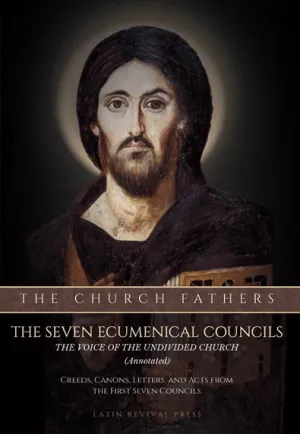
Start with the creeds and definitions, which are short, before the longer letters and canons. Read one council at a time, with the corresponding paragraphs of the Catechism beside you. Latin Revival’s The Seven Ecumenical Councils: The Voice of the Undivided Church gathers key documents from all seven councils with introductions and annotations, so a reader can meet the councils in their own words.
Sources and further reading
- Catechism of the Catholic Church, 242–248: the Trinity in the Creed
- Catechism of the Catholic Church, 464–478: true God and true man
- Catechism of the Catholic Church, 2129–2132: sacred images
- Catechism of the Catholic Church, 880–891: the college of bishops and the Pope
- Second Vatican Council, Lumen Gentium, 22
- First Council of Nicaea (325): introduction and texts (Papal Encyclicals Online)
- Council of Chalcedon (451): introduction and texts (Papal Encyclicals Online)
- Second Council of Nicaea (787): introduction and texts (Papal Encyclicals Online)
Buy buttons open your country’s Amazon store. As an Amazon Associate I earn from qualifying purchases.