
St. Augustine’s Confessions has been read for more than sixteen centuries, and it still surprises first-time readers. They expect a memoir and find a prayer. They expect a story of youthful sin and find long reflections on memory, time and the first chapter of Genesis. Knowing what kind of book it is makes all the difference.
What kind of book is it?
Augustine (354–430) was bishop of Hippo in North Africa when he wrote the Confessions, around the year 400. He had been baptized in Milan in 387 by St. Ambrose after a long search that led him through ambition, false religion and philosophy.
The book is three things at once:
- An autobiography. It tells the story of his life from infancy to his conversion and the death of his mother, St. Monica.
- A prayer. The whole book is addressed to God. Augustine is not telling us about God so much as speaking to Him while we listen.
- A work of theology. Along the way he reflects on sin and grace, on the nature of memory and time, and on creation.
The word confession has a double meaning for Augustine. It is the confession of his sins, but also the confession of God’s praise. The book opens with praise and keeps returning to it.
How the thirteen books are arranged
- Books 1–9 tell the story: childhood and school, the famous theft of pears, student life in Carthage, his attraction to the Manichees, his career as a teacher of rhetoric, his move to Rome and Milan, his meeting with Ambrose, his conversion in a garden, his baptism, and the death of Monica.
- Book 10 turns from past to present. Augustine examines the mystery of memory and how one finds God within it, and honestly lists the temptations he still faces as a bishop.
- Books 11–13 reflect on time, on creation and on the opening chapter of Genesis.
Many readers find the change at Book 10 abrupt. It is deliberate. Having told how God found him, Augustine asks what it means to know and praise God now.
A manageable way to read it
- Read Books 1–9 first, at a steady pace. A chapter or two each day will take you through the story in a few weeks. The chapters are short.
- Read it as prayer. Begin each session by asking God for the light Augustine sought. When he addresses God, let the words become yours.
- Do not get stuck on the philosophy. Augustine’s arguments with the Manichees and his reflections on Neoplatonism (Books 3–7) can be dense. Read for the main point: he was searching for a truth he could not yet see.
- Read Book 10 slowly. It is one of the great meditations on the inner life. Take it a few pages at a time.
- Treat Books 11–13 as a second stage. Some readers read them straight on; others return to them after living with the first ten. Either is fine.
- Keep a short list of passages that strike you. You will want to find them again.
Five themes to watch for
Desire. Augustine is a man of great longing. The book’s most famous line, quoted by the Catechism, comes in its first paragraph: “you have made us for yourself, and our heart is restless until it rests in you.” His sins are disordered loves, good desires aimed at the wrong things.
Memory. Remembering is how Augustine reads his own life in the light of God’s mercy. In Book 10 he explores memory as the vast inner place where he searches for God and finds that God was already there.
Conversion. His conversion is not a single moment but a long struggle of the will. In the garden at Milan he hears a child’s voice repeating, in the New Advent translation, “Take up and read; take up and read,” opens St. Paul and finally finds the strength to change.
Grace. Augustine insists that he did not find God by his own cleverness or effort. God sought him first, through his mother’s prayers, through friends, through Ambrose’s preaching and through Scripture.
Praise. The book is finally an act of thanksgiving. Its best-known prayer, in Book 10, begins in the same translation: “Too late did I love You, O Fairness, so ancient, and yet so new!”
Reading it as a Catholic today
Augustine is honest about his past, including his long relationship with a woman who was not his wife and the son they had together, Adeodatus. He writes about these things not to shock but to praise God’s mercy, and he writes with tenderness for his son.
Some of his opinions on secondary questions reflect the learning of his time, and later Church teaching has refined certain points of his theology. But the heart of the Confessions, the restless heart seeking God and found by grace, has never stopped speaking to the Church. Pope Benedict XVI devoted a series of general audiences to Augustine in 2008, a helpful companion for anyone who wants to know the saint better.
About this edition
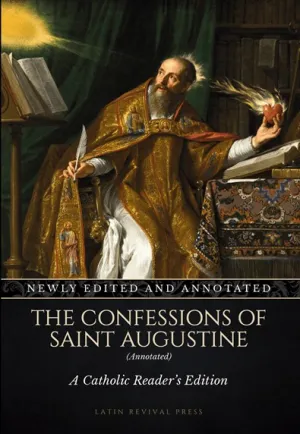
Latin Revival’s The Confessions of Saint Augustine (Annotated) presents J. G. Pilkington’s nineteenth-century translation. The quotations above follow the Catechism and New Advent’s lightly revised version of Pilkington, so their wording may differ slightly from the printed edition.
Not sure the Confessions is the right place to begin? See Which Catholic Spiritual Classic Should You Read First?
Sources and further reading
- Catechism of the Catholic Church, 27–30: the desire for God
- St. Augustine, Confessions, trans. J. G. Pilkington (New Advent)
- Pope Benedict XVI, General Audience on St. Augustine, part 1 (9 January 2008)
- Pope Benedict XVI, General Audience on St. Augustine, part 2 (16 January 2008)
- Catholic Encyclopedia: “Saint Augustine of Hippo”
Buy buttons open your country’s Amazon store. As an Amazon Associate I earn from qualifying purchases.