
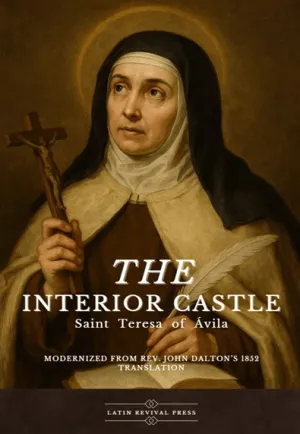
Few books on prayer are as admired, or as intimidating, as The Interior Castle. St. Teresa of Ávila wrote it near the end of her life, and in it she describes the soul’s journey toward union with God more fully than anywhere else in her writings. Readers who open it for the first time often meet unfamiliar terms, long digressions and descriptions of mystical graces that seem far beyond them.
They need not be discouraged. Teresa wrote for her sisters, not for scholars, and she wrote with warmth, humour and great common sense. With a little orientation, a beginner can read her with profit.
Who was St. Teresa of Ávila?
Teresa de Ahumada was born in Ávila, Spain, in 1515 and entered the Carmelite convent of the Incarnation there as a young woman. After years of what she later called a divided life, she experienced a deep conversion and went on to found a series of reformed Carmelite convents, the Discalced Carmelites, with the help of St. John of the Cross. She died in 1582 and was canonized in 1622. In 1970 Pope St. Paul VI declared her a Doctor of the Church, the first woman to receive that title.
The Catechism quotes her definition of prayer in its section on contemplative prayer: prayer is “nothing else than a close sharing between friends.” That phrase is a good key to the whole Interior Castle. Its subject is friendship with God.
When and why she wrote it
Teresa wrote The Interior Castle under obedience in 1577. She began it in Toledo in June and finished it at the convent of St. Joseph in Ávila in November. Pope Benedict XVI called it her “most famous mystical work.”
She wrote it as a practical guide for her nuns, many of whom wanted to understand their experience in prayer. That explains its tone: affectionate, direct, often humble about her own understanding.
The image of the castle
At the beginning of the book Teresa describes the image that came to her. In the Stanbrook translation she writes that she thought of the soul “as resembling a castle, formed of a single diamond or a very transparent crystal, and containing many rooms.” At the centre of the castle, in the innermost dwelling place, God lives.
Two points in this image matter for beginners:
- The soul is beautiful. Teresa begins not with sin but with the dignity of a soul made in God’s image and indwelt by Him. Sin darkens the castle; it does not make it worthless.
- The way in is prayer. In the same chapter she writes, in that translation, that “the gate by which to enter this castle is prayer and meditation.” Everything in the book follows from a life of prayer.
The seven mansions, briefly
Teresa groups the castle’s many rooms into seven “mansions” or dwelling places. A short orientation:
- First and second mansions: the soul has begun to pray, but is still much distracted by worldly concerns and struggles to persevere. Self-knowledge and humility are the great lessons here.
- Third mansions: a well-ordered, virtuous Christian life, with regular prayer, but a risk of complacency and of wanting God on one’s own terms.
- Fourth mansions: the beginnings of prayer in which God acts more directly than our own efforts. Here Teresa insists that what matters is not to think much but to love much.
- Fifth to seventh mansions: deeper union with God, purifying trials and finally what she calls the spiritual marriage, the soul’s abiding union with God at the centre.
Not a checklist
It is tempting to read the mansions as a staircase, and to ask, “Which mansion am I in?” Teresa does not encourage that kind of measuring.
She says there are many rooms in each mansion, not just seven. Souls move back and forth. The graces of the later mansions are gifts that God gives as He wills, not achievements that follow automatically from technique or effort. She also teaches that the surest sign of growth is not unusual experience but humility and love of neighbour.
So read the later chapters with reverence, but without anxiety. They describe where God can lead, not a test you are failing.
A practical way to begin
- Read the opening chapters slowly. The first mansions, on the dignity of the soul, prayer and self-knowledge, speak to almost everyone. Do not hurry past them to the more mystical chapters.
- Read a little at a time. One chapter in a sitting is plenty. Pause when a sentence touches you.
- Keep praying. The book is meant to be read by someone who prays. A daily time of quiet prayer, even ten or fifteen minutes with the Gospels, is the best commentary on Teresa.
- Be patient with digressions. Teresa often interrupts herself. The asides are part of her charm and often contain her best advice.
- Talk with a confessor or spiritual director if the book raises questions about your own prayer, especially about unusual experiences. Teresa herself relied on wise and learned guides.
- Return later. Many readers find that the book opens up on a second or third reading, years apart.
About this edition
Latin Revival’s edition of The Interior Castle presents the English translation of Rev. John Dalton, first published in 1852. Its English is older than some modern translations, so read aloud when a sentence feels dense. The quotations above are from the 1921 Stanbrook translation, which is freely available online; Dalton’s wording differs slightly.
If you are still deciding which classic to begin with, see Which Catholic Spiritual Classic Should You Read First?
Sources and further reading
- Catechism of the Catholic Church, 2709–2719: contemplative prayer
- Pope Benedict XVI, General Audience on St. Teresa of Avila (2 February 2011)
- St. Teresa of Ávila, The Interior Castle, First Mansions, chapter 1 (Stanbrook translation)
- Introduction to the Stanbrook translation, on the writing of the book
- Pope St. Paul VI, homily proclaiming St. Teresa a Doctor of the Church (27 September 1970, Italian)
Buy buttons open your country’s Amazon store. As an Amazon Associate I earn from qualifying purchases.