
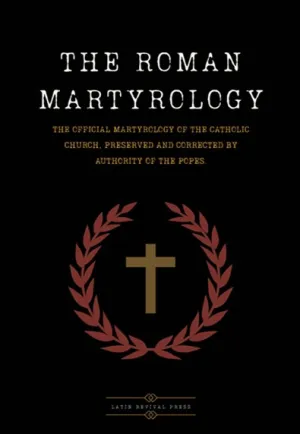
Every day of the year, the Church remembers far more saints than are ever mentioned at Mass. Their names are kept in a book called the Roman Martyrology. Many Catholics have never seen it, yet it has been read in monasteries and religious houses for centuries, and it can become a simple, beautiful part of family life.
What is the Roman Martyrology?
The Catholic Encyclopedia defines a martyrology as “a catalogue of martyrs and saints arranged according to the order of their feasts, i.e., according to the calendar.” The Roman Martyrology is the official version of that catalogue for the Roman Rite. For each day of the year it lists the saints and blessed commemorated that day, each with a short notice: a name, a place, often a few lines about the person’s life or death.
Despite its name, it is not only a list of martyrs. It includes bishops, virgins, monks, missionaries, mothers and fathers, kings and the poor: men and women of every age who are honoured as saints or blessed.
Where it came from
The Martyrology grew out of the early Church’s custom of remembering its martyrs on the anniversaries of their deaths. Over the centuries many local lists were compiled. In 1583, by order of Pope Gregory XIII, a Roman Martyrology was published in Rome, and an edition of 1584 was approved and prescribed for the whole Church. The historian Cardinal Caesar Baronius soon added his notes, and later popes, including Urban VIII and Benedict XIV, issued revised editions.
After the Second Vatican Council the Martyrology was thoroughly revised. A new official Latin edition appeared in 2001, and a second edition in 2004 added those beatified or canonized by Pope St. John Paul II and made corrections. The 2001 edition contains more than six thousand entries.
How it relates to the Church’s calendar
It helps to distinguish two things.
- The liturgical calendar governs what the Church celebrates at Mass and in the Liturgy of the Hours: solemnities, feasts and memorials, some obligatory and some optional. National and diocesan calendars add their own saints.
- The Martyrology remembers many more holy men and women on each day than are ever celebrated in the Mass of that day.
So the Martyrology does not replace the calendar. If your parish celebrates a particular saint on a given day, that comes from the calendar. The Martyrology is a wider memory, a reminder that each day belongs to a great crowd of witnesses.
How the Church uses it
For centuries, the entries for the following day were read aloud in choir at the hour of Prime, or in the refectory at a meal. Since the reform of the Liturgy of the Hours, communities that pray the Office together read the Martyrology at a suitable moment, and the current edition provides forms for reading it after one of the Hours, at table or at a community meeting.
One entry is known to many Catholics without their realising its source. The solemn Christmas Proclamation, which announces the birth of Christ against the backdrop of the history of salvation, comes from the Martyrology. The U.S. bishops note that it may be chanted or recited, most fittingly on December 24 during the Liturgy of the Hours, and it may also be used before the Christmas Mass during the Night.
Short notices, not full biographies
A Martyrology entry is brief by design. Some are a single line. They are not biographies, and they do not answer every question a child might ask.
Older editions sometimes repeat traditional accounts that later historians examined more critically; that is one reason the Church has revised the Martyrology over the centuries. Latin Revival’s edition presents the traditional Martyrology, arranged day by day. Because the Church’s current official edition dates from 2001 and 2004, some dates and entries in a traditional edition differ from today’s calendar. That is part of its interest: it preserves the Church’s long memory of her saints.
A simple way for families to read an entry
The Martyrology lends itself to a few quiet minutes at the end of a meal or before bed.
- Read the entry for the day, or, as religious communities traditionally did, the entry for tomorrow.
- Choose one saint from the list. Do not try to cover everyone.
- Find the place on a map. Children are often amazed at how far the Church has spread.
- Talk about one thing the saint did: a brave choice, a kindness, faithfulness in hardship.
- Pray together briefly: “Saint N., pray for us.”
- Learn more about a saint who catches a child’s interest from a fuller life of the saint.
With young children, read ahead first. Some entries describe martyrdom plainly; parents can decide how much to share.
Patron saints, name days and feasts
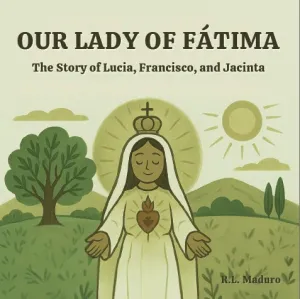
The Martyrology is a natural companion to the Church’s year. Look up the saints whose names your children bear, and mark those days in the family calendar. Read about a saint on or near the feast day. On 13 May, the optional memorial of Our Lady of Fátima in the General Roman Calendar, a family might read a chapter of Our Lady of Fátima: The Story of Lúcia, Francisco, and Jacinta together. On Christmas Eve, read the Christmas Proclamation aloud before the family celebration.
Over a year, children come to know that the saints are not a few famous names but a vast family, and that they too are called to belong to it.
For more ideas on shared reading at home, see A Family’s First Catholic Books: What to Read with Children.
Sources and further reading
- Catholic Encyclopedia: “Martyrology”
- Holy See Press Office, presentation of the new Martyrologium Romanum (2 October 2001, Italian)
- USCCB: The Christmas Proclamation
- Bishops’ Conference of England and Wales: additions to the General Roman Calendar in the third edition of the Roman Missal (PDF)
- Catechism of the Catholic Church, 1163–1173: the liturgical year and the memorials of the saints
Books in this article
Buy buttons open your country’s Amazon store. As an Amazon Associate I earn from qualifying purchases.