
Few books have shaped Catholic prayer as deeply as the Spiritual Exercises of St. Ignatius of Loyola. Saints and popes have made them, generations of retreatants have been formed by them, and Pope Pius XI called Ignatius “the chief and peculiar Master of Spiritual Exercises.” Yet many Catholics who have heard the name are unsure what the Exercises actually are.
This guide explains their purpose and structure for lay readers. It cannot replace the experience of making the Exercises, ideally with the help of an experienced director, but it can show why that experience is worth seeking.
A book to be made, not only read
The first surprise is that the Spiritual Exercises is not a book meant to be read straight through like a treatise. It is a handbook of meditations, contemplations, examinations of conscience and practical rules, written mainly for the person who gives the Exercises to someone else. Ignatius compared them to bodily exercise: as walking and running exercise the body, so these exercises prepare and dispose the soul.
Ignatius (1491–1556), a Basque soldier converted while recovering from a wound, wrote down what he had learned in his own prayer and in guiding others. Pope Paul III approved the Exercises in a brief of 1548, using the words “We approve, praise, and favor.” Pius XI later named Ignatius the patron of spiritual exercises and promoted them in his encyclical Mens Nostra (1929).
What the Exercises are for
Ignatius states their purpose at the head of the book. In the 1914 translation of Fr. Elder Mullan, S.J., they are exercises “to conquer oneself and regulate one’s life without determining oneself through any tendency that is disordered.” In other words, they help a person become free enough to choose what God wants, rather than what fear, vanity or habit dictates.
Everything rests on the First Principle and Foundation, which begins in the same translation: “Man is created to praise, reverence, and serve God our Lord, and by this means to save his soul.” From that starting point, the Exercises ask how each person’s life, decisions and attachments can be ordered toward God.
How they are structured
The full Exercises are divided into four “Weeks.” These are stages, not calendar weeks; Ignatius says the whole retreat takes about thirty days, “a little more or less,” and each stage is shortened or lengthened as needed.
- The First Week considers sin and the mercy of God. The retreatant comes to know himself as a loved sinner.
- The Second Week contemplates the life of Christ, from the Incarnation through His public ministry. It opens with the meditation on the call of Christ the King and includes the meditation on the Two Standards, the standard of Christ and that of the enemy of our human nature. Here many retreatants face a decision about their state of life or another serious choice.
- The Third Week accompanies Christ in His Passion and death.
- The Fourth Week contemplates His Resurrection and appearances, and ends with a contemplation for obtaining the love of God.
Alongside these meditations come practical tools: the particular and general examinations of conscience, methods of prayer, and rules for discerning spirits.
Discernment: more than following feelings
The rules for the discernment of spirits are among the best-known parts of the Exercises, and among the most misunderstood. Ignatius does pay close attention to interior movements. He describes consolation, in Mullan’s translation, as “every increase of hope, faith and charity, and all interior joy which calls and attracts to heavenly things,” and desolation as its contrary, including “darkness of soul, disturbance in it, movement to things low and earthly.”
But discernment is not simply doing what feels good. Consolation is defined by growth in faith, hope and charity, not by pleasant emotion. The rules teach how to recognise deceptions that look like good, how to remain steady in desolation and not to change one’s resolutions in it, and how to test movements over time. And all of this happens within the faith and moral teaching of the Church, which discernment never overrides.
That is why Ignatius wanted the Exercises given by someone experienced. He asks the director to stand “in the centre like a balance,” leaving the retreatant free while helping him notice what is happening in prayer. The Catechism, too, recognises that the Holy Spirit gives some of the faithful gifts of wisdom and discernment for the sake of spiritual direction.
Ways of making the Exercises today
Ignatius himself expected the Exercises to be adapted to each person’s circumstances, age and ability. Today they are commonly made in several ways:
- The full thirty-day retreat, in silence and seclusion, as Ignatius describes.
- The Exercises in daily life, following his nineteenth annotation: a person with ordinary responsibilities sets aside time for prayer each day and meets a director regularly, working through the Exercises over several months.
- Shorter retreats, often of eight days or a weekend, which draw on the main meditations of the Exercises.
Many Jesuit and other retreat houses, and many parishes, offer one or more of these forms.
What a lay reader can begin with now
- The daily Examen. Ignatius’s general examination of conscience, made briefly each evening, is a good first practice: give thanks, ask for light, review the day, ask pardon and resolve for tomorrow.
- Praying with the Gospels. Choose a scene from the life of Christ and enter it with your imagination, then speak to Him simply.
- A guided retreat. If you can, make a retreat with a director.
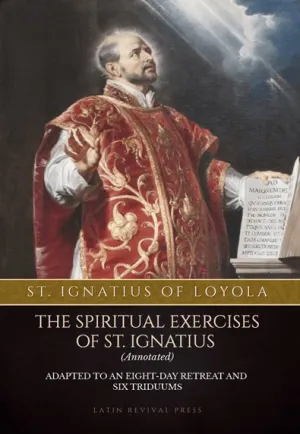
Latin Revival’s edition of The Spiritual Exercises of St. Ignatius of Loyola presents Fr. Charles Coppens, S.J.’s adaptation of the Exercises for an eight-day retreat. Fr. Coppens (1835–1920) prepared it for Jesuit retreatants, and its arrangement of the main meditations, from the purpose of life through the Passion and Resurrection to the love of God, makes it a helpful companion for a personal retreat or a period of renewal. Read it slowly and prayerfully, and where possible bring what you find to a priest or spiritual director.
For a comparison with other classics, see Which Catholic Spiritual Classic Should You Read First?
Sources and further reading
- St. Ignatius of Loyola, The Spiritual Exercises, trans. Elder Mullan, S.J. (1914): annotations
- The Spiritual Exercises: First Principle and Foundation (Mullan translation)
- The Spiritual Exercises: rules for the discernment of spirits (Mullan translation)
- Pope Pius XI, Mens Nostra (1929), on promoting the Spiritual Exercises
- Catechism of the Catholic Church, 2690: spiritual direction
- Catechism of the Catholic Church, 2705–2708: methods of meditation
- Loyola Press: What Are the Spiritual Exercises?
Buy buttons open your country’s Amazon store. As an Amazon Associate I earn from qualifying purchases.